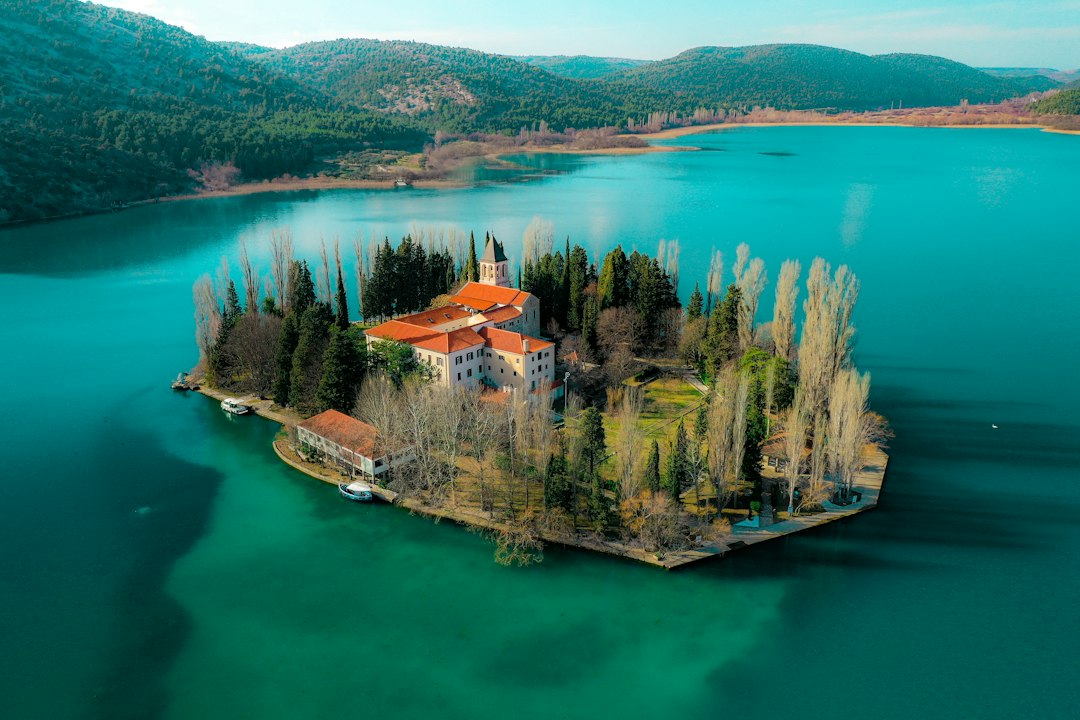

The scent of wild lavender and pine resin greets you even before you see the walls of the Krka Monastery. Located on a small island in the Krka River, a few kilometers from the town of Knin and near the village of Puljane, this Serbian Orthodox complex seems to exist in its own temporal dimension, separate from the flow of tourists that crowd the nearby Krka National Park every year. Yet, just a few steps beyond the gate, you find yourself in one of the quietest and most authentic monastic gardens in Croatia.
The monastery is dedicated to Archangel Michael, and its origins date back to the 14th century, with some sources indicating 1345 as the year of its founding, during the reign of the Šubić dynasty and later under the patronage of Serbian nobles. In the following centuries, the complex underwent destruction and reconstruction, especially during the Ottoman incursions, but the garden that surrounds it today tells a story of silent resilience: gnarled olive trees that could be hundreds of years old, spontaneous flower beds of wildflowers, and a silence interrupted only by the singing of birds and the distant flow of the river.
The garden: between wild and sacred
What immediately strikes the visitor is the coexistence of the cultivated and the spontaneous. The olive trees — some with trunks so gnarled they look like sculptures — grow alongside aromatic plants that the monks cultivate for their own use. In spring and early summer, the ground around the walls is covered with red poppies, wild daisies, and wildflowers that no one seems to have deliberately planted. The impression is that of a garden that has made itself, guided only by the seasons and the discreet care of those who live there.
The perimeter of the garden is marked by a low wall made of local limestone, typical of Dalmatian architecture, and inside there are some wooden benches where it is possible to sit in complete silence. There are no tourist signs explaining each plant, there are no audio guides: the garden speaks through the senses, not through words. The almost total absence of other visitors — even in the summer months — is perhaps the most surprising detail for those arriving directly from the chaos of the national park.
The church and the frescoes: what to observe up close
The heart of the complex is the monastic church, whose interior preserves frescoes and icons from the Serbian Orthodox school. Some of the displayed icons date back to the 17th and 18th centuries and show the influence of the post-Byzantine painting tradition. It is worth pausing to observe the iconostasis, the decorated dividing wall that separates the nave from the presbytery: it is a characteristic architectural and spiritual element of Orthodox churches, and that of the Krka Monastery is considered a significant example of religious craftsmanship from the northern Dalmatia region.
The monastery still hosts an active monastic community today, which means that some areas may be closed to visitors during religious services. It is good practice to dress modestly — shoulders and knees covered — and to maintain silence inside the buildings. Entrance to the complex is generally free or requires a voluntary donation, but it is advisable to check the updated conditions before visiting.
How to get there and when to visit
The monastery is easiest to reach by car, taking the state road that connects Knin to Šibenik and exiting towards Puljane. It is about 35 kilometers from Šibenik, while the distance from Knin is about 15 kilometers. There is no direct and regular public transport service to the monastery, so a car or a bicycle remain the most practical options. Once you arrive at the small parking lot, you reach the island via a short pedestrian bridge.
The best time to visit is early in the morning, between 8 and 10, when the sunlight filters through the olive trees and the garden is still cool. During this time frame, the monastery is almost always deserted. Avoid the afternoons in July and August, not so much for the crowd — which is always small here — but for the intense heat that makes outdoor stays less pleasant. A complete visit, including the church and a tour of the garden, takes about an hour, but those who simply enjoy sitting in silence might stay much longer.
Why the Detour is Worth It
The Krka Monastery does not compete with the waterfalls of the national park in terms of visual spectacularity. It offers something different: the chance to stand still in a beautiful place without feeling the need to photograph every corner. The garden, with its scents and its unruly colors, reminds us that certain places were not designed for tourists but for those who live there — and that for this reason they deserve a visit.
If you are planning a day at Krka National Park, consider dedicating the early hours of the morning to the monastery before heading to the waterfalls. You will be surprised by how much that half hour of silence changes the way you view the rest of the day.