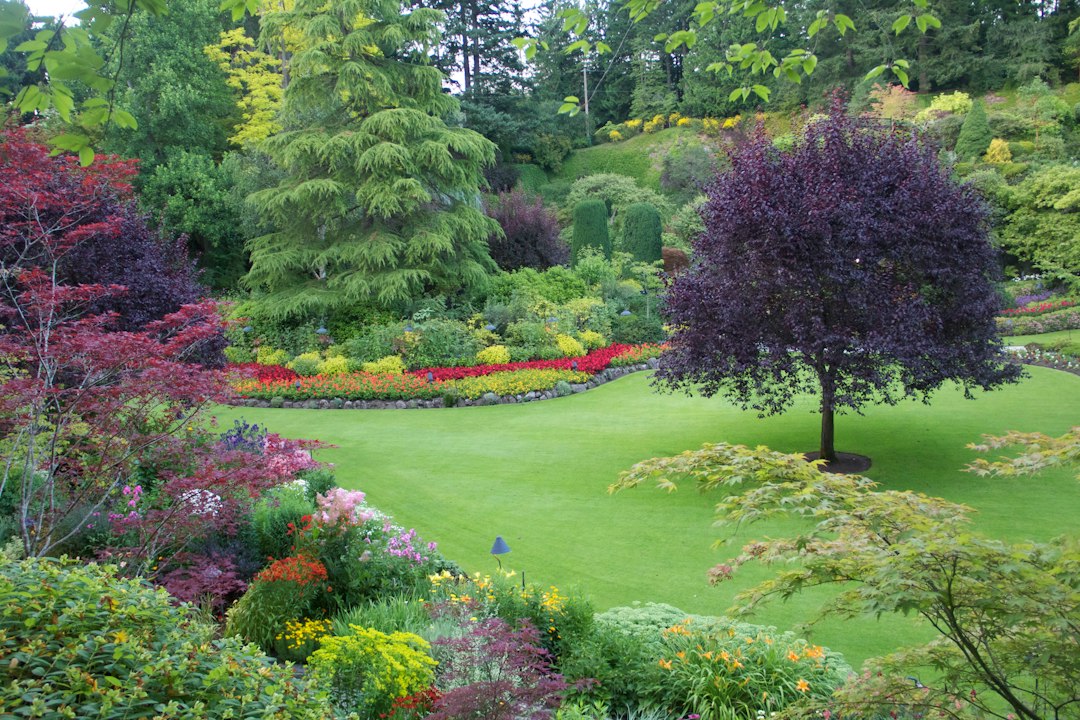
One million blooming plants emerging from the bottom of an ancient limestone quarry: this is the image that welcomes visitors to the Sunken Garden, the beating heart of Butchart Gardens in Brentwood Bay, on Vancouver Island, Canada. What is now one of the most stunning botanical displays in the country was, at the beginning of the twentieth century, a gray and silent pit, emptied by the intensive extraction of limestone destined for cement production.
The transformation is due to Jennie Butchart, wife of Robert Pim Butchart, an entrepreneur who had started the extraction business around 1904. When the quarry was exhausted, Jennie did not see a wound in the landscape, but an opportunity. Around 1912, she began to fill the depression with manually transported soil, planting the first flowers along the still visible rocky walls. That stubborn and creative vision is the foundation of what still exists today.
The descent into the garden: a physical experience before being a visual one

Approaching the Sunken Garden literally means going down: the paths lead the visitor downward, below the level of the surrounding ground, between walls of limestone that in some places reach considerable heights. This immersion effect is unique and cannot be perceived in photographs. The original rocky walls are still visible and contrast with the vibrant colors of the flower beds that surround them, creating a continuous dialogue between the hardness of the stone and the softness of the petals.
The floral compositions change with the seasons: in spring, tulips and daffodils dominate, in summer begonias, geraniums, and dahlias, in autumn the tones become warmer with chrysanthemums and ornamental plants. Each arrangement is designed to create an effect of a chromatic carpet that can only be seen in its entirety from above, from the viewpoints overlooking the edge of the quarry. It is worth stopping at these elevated points before descending, to grasp the overall geometry.
Butchart Gardens: numbers and context
The Sunken Garden is the most famous section of a larger complex, the Butchart Gardens, which spans approximately 22 total hectares and also includes the Italian Garden, the Japanese Garden, and the Rose Garden. The site has been designated a National Historic Site of Canada since 2004, a recognition that certifies its historical and landscape value. The gardens host about one million visitors each year, with peaks concentrated in the summer months between June and September.
The entrance ticket price varies depending on the season: during peak seasons, the cost for adults is around 35-40 Canadian dollars, with discounts for children and seniors. The gardens are still managed today by the descendants of the Butchart family, which ensures continuity in the care and original philosophy of the project. Within the site, there are restaurants, a café, and a plant shop, all integrated into the environment without altering its atmosphere.
When to visit and how to organize
The best season to visit the Sunken Garden is between July and August, when the blooming is at its peak and the colors reach their maximum intensity. However, those who wish to avoid the crowd might prefer June or September, months when the garden is still in full form but less crowded. In summer, the gardens remain open until the evening hours, and on Saturday nights, fireworks shows are organized, visible from inside the complex: a completely different experience compared to the daytime visit.
To reach Brentwood Bay from Victoria, the nearest city, you can take a local bus or rent a car: the journey takes about 30 minutes. There is also a seasonal ferry service that connects Victoria directly to the gardens by sea, a scenic and convenient option. It is recommended to dedicate at least two and a half hours to the visit to be able to calmly explore all sections of the complex, including the Sunken Garden. Arriving at opening time, generally around 9:00 AM, allows you to enjoy the morning light and photograph the garden before it fills up with visitors.
A detail that leaves an impression
Among all the elements of the Sunken Garden, one in particular strikes those who visit for the first time: the original rocky walls of the quarry, on which climbing plants and cascades of hanging flowers grow. Jennie Butchart had them covered with ivy and flowers as early as the first years of the project, and that choice to embrace the rock instead of hiding it is still today the hallmark of the garden. It is not a park that erases its industrial past: it transforms it, inhabits it, makes it beautiful. And this, more than any number or statistic, explains why the Sunken Garden continues to attract visitors from all over the world more than a century after its creation.