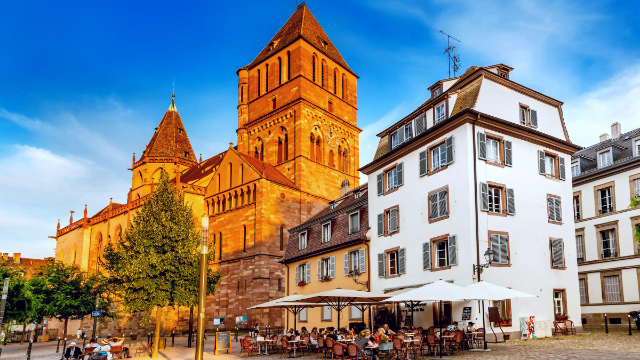

The Protestant Church of Saint-Thomas is an excellent example of Alsatian Gothic art.he origins of the church building go back to a Benedictine monastery from the year 600. The monastery was dedicated to the apostle Thomas. Bishop Adalog ordered a new church and school to be built here in the 9th century. However, in 1007 a lightning strike hit the building and a fire reduced it to rubble. The actual construction of the church as we know it today therefore began in the 12th century. Thanks to an indulgence privilege, the construction of the façade could be started in 1196. The oldest part of the church is the Blasius Chapel north of the choir. The nave was completed at the end of the 13th century. In 1330, two additional naves were added. The city of Strasbourg arranged for the construction of a school in 1536.
St. Thomas Church is a five-nave hall church. The length inside is 65 metres, the width 30 metres and the interior height 22 metres. In terms of style, the building represents a mixture of Romanesque and Gothic elements. The earliest building elements still belong to the Romanesque tradition, such as the massive gate tower. The transept with the crossing tower, which was built in the 13th century, and the choir bear Gothic forms. The side chapels, which were not built until the 16th century, are in the late Gothic style. Of the original medieval leaded glass windows, only the rose window is still in the façade. The remaining windows are mainly decorated with plant motifs, after many of the depictions of saints fell victim to Lutheran iconoclasts. St. Thomas' Church converts to the Lutheran faith In 1524, St. Thomas Church turned to the Lutheran faith. Even when Alsace was annexed by Catholic France, the church retained its Lutheran ethos. The same was true of the collegiate foundation and its possessions. Later, the Thomaskirche was the place where Friedrich Spitta rehearsed new forms of worship in the course of the "older liturgical movement".
Andreas Silbermann achieved an imposing organ in the Thomaskirche in the 17th century. Wolfgang Amadeus Mozart played on it in 1778, and later Albert Schweitzer in memory of Johann Sebastian Bach. In 1979 the Silbermann organ was restored by Alfred Kern. In addition to the Silbermann organ, the Thomaskirche also has a second, smaller organ. In 1905 Fritz Haerpfer built the smaller choir organ according to the plans of Albert Schweitzer.
St. Thomas Church is famous for its funerary monuments. The monuments date from between 1130 and 1850, including the Romanesque tomb of Bishop Adelog from the 12th century. Also worth seeing is the tomb of the French commander Marshal Moritz of Saxony, who died in 1750. The monument was completed in 1776 by Jean-Baptiste Pigalle. The imposing tomb is located in the apse and shows the marshal striding down a staircase into the coffin, while the figuratively depicted France tries to hold him off.