
← Back

Palazzo San Giorgio and Marco Polo

Palazzo San Giorgio, 2, 16126 Genova GE, Italy ★★★★☆ 202 views
Carla Linz
Genova
🏆 AI Trip Planner 2026

Get the free app

Discover the best of Genova with Secret World — the AI trip planner with 1M+ destinations. Get personalized itineraries, hidden gems and local tips. Free on iOS & Android.

🧠 AI Itineraries 🎒 Trip Toolkit 🎮 KnowWhere Game 🎧 Audio Guides 📹 Videos
Scan to download iOS / Android
Scan for AppGallery Huawei users

About Palazzo San Giorgio and Marco Polo

Palazzo San Giorgio and Marco Polo - Genova | Secret World Trip Planner

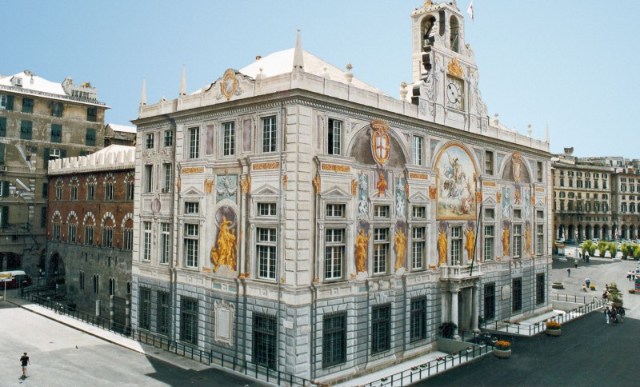
PALAZZO SAN GIORGIO OR THE Palace of Saint George, may not be among Genoa’s top tourist attractions, but its historic significance is more than worth noting. Not only is it the site where Marco Polo’s famous memoirs were written, but it also once housed one of the oldest banks in history. Nowadays it hosts the headquarters of the Autorità di Sistema Portuale del Mar Ligure Occidentale. The palace is located in the docks area and is formed by two different parts: the ancient one, a typical example of medieval architecture, front pointed towards the Sottoripa portico, and the Renaissance one, oriented south. The main entrance is located on this side in front of the Porto Antico, facing via della Mercanzia, a small alley that links piazza Caricamento to piazza Cavour.

Palazzo San Giorgio and Marco Polo - Genova | Secret World Trip Planner

The palace was built between 1257 and il 1260 and was commissioned by the Capitano del Popolo Guglielmo Boccanegra, who wanted to realize the headquarters of the civic power in order to differentiate it from the religious power, installed in the Cattedrale di San Lorenzo. The design for the new public palace was entrusted to Frate Oliverio, a Cistercian monk, who had already designed he extension of the Ancient Dock to the sea, thanks to his technical skills. According to a legend, during the second half of the 13th century, in this palace Marco Polo was held prisoner.

Since 1340 the palace became the headquarters of the judiciaries authorities for the supervision of port trades and here were installed the customs and the offices of the so called Compere, the authorities entrusted with the management of credit from citizens to the Municipality. In 1407 all the Compere were reunited under a single authorty: it was the birth of the Casa delle Compere e dei Banchi di San Giorgio, one of the first banks, born in Italy. Since 1451 the entire building was managed by the Bank of San Giorgio, and got its name.

In 1903 the palace became the headquarters of the Port Authorities, which was called Consorzio Autonomo del Porto di Genova.


🗺 La app de los tesoros hispanos

Plan your visit to Genova

Suggested itinerary near Palazzo San Giorgio and Marco Polo

MAJ+
500.000+ travelers worldwide
  1. 🌅
    Morning
    Palazzo San Giorgio and Marco Polo
    📍 Genova
  2. ☀️
    Afternoon
    Museum of the history of Genoa
    📍 0.1 km · Genova
  3. 🌆
    Evening
    Cathedral of San Lorenzo
    📍 0.3 km · Genova

Buy Unique Travel Experiences

Powered by Viator

See more on Viator.com

Explore nearby · Genova

Frequently Asked Questions

According to legend, Marco Polo was held prisoner in Palazzo San Giorgio during the second half of the 13th century, and it was during this time that his famous memoirs were written. While this story is historically debated, it remains one of the palace's most famous associations and is a key reason for its historical significance in Genoa.
The palace is located in Genoa's docks area, with its main entrance situated in front of Porto Antico on via della Mercanzia, a small alley connecting piazza Caricamento to piazza Cavour. The building's Renaissance section faces south toward the ancient harbor, making it easily accessible from the main waterfront areas.
In 1407, the Compere authorities were unified under a single entity to create the Casa delle Compere e dei Banchi di San Giorgio, which was one of the first banks ever established in Italy. The entire Palazzo San Giorgio became the bank's headquarters from 1451 onwards, playing a crucial role in medieval European financial history.
While the palace now serves as the headquarters of the Port Authority (Autorità di Sistema Portuale del Mar Ligure Occidentale) and isn't a traditional tourist attraction, you can view its exterior architecture. The building features two distinct architectural styles: a medieval section facing the Sottoripa portico with typical 13th-century design, and a Renaissance section oriented toward the south.
The palace was constructed between 1257 and 1260 under the commission of Guglielmo Boccanegra, the Capitano del Popolo, who wanted to establish a civic power headquarters separate from the religious authority at the Cathedral of San Lorenzo. The design was created by Frate Oliverio, a skilled Cistercian monk known for his architectural and engineering expertise.