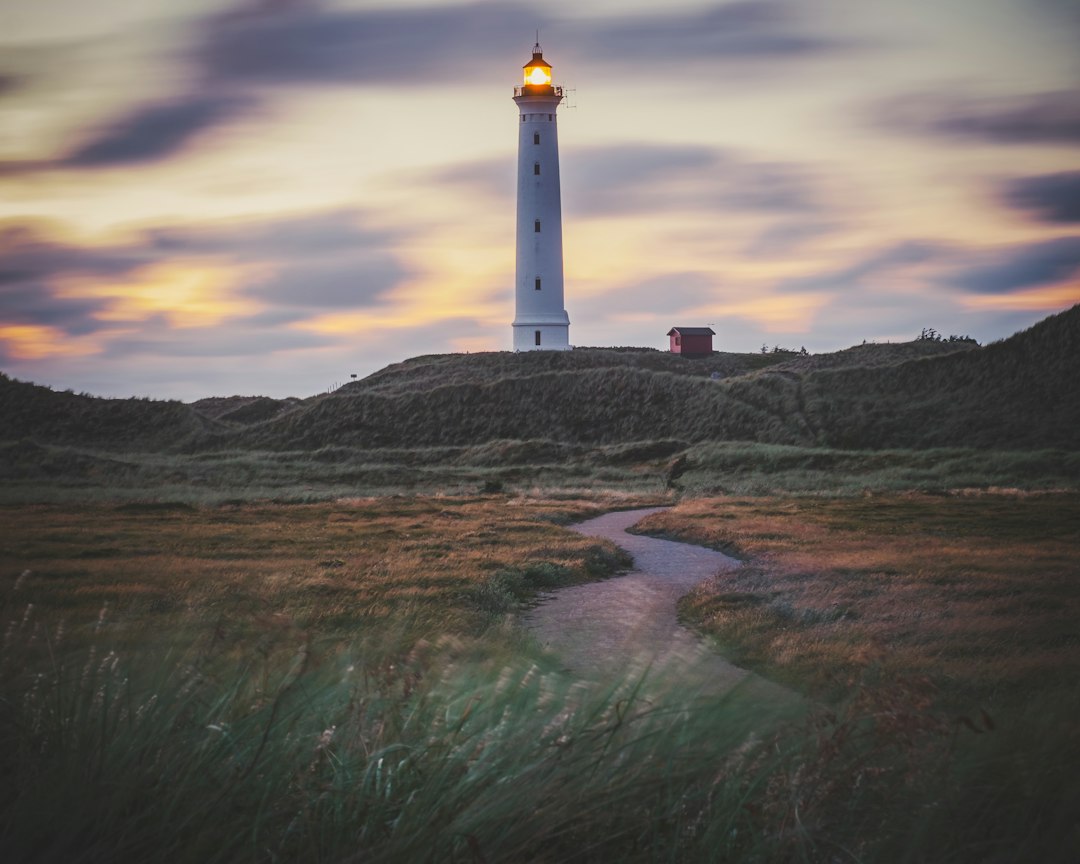

Red bricks against the gray sky of Jutland. The Lyngvig lighthouse stands solitary among the shifting dunes of the Danish peninsula, visible from afar like a lit signal in the flat and windy landscape of the western coast. Built in 1906, this lighthouse, about 38 meters tall, has guided vessels for decades along one of the most treacherous stretches of sea in Northern Europe, where the currents of the North Sea become unpredictable and fog can descend without warning.

What makes Lyngvig truly unique is not only its red brick structure — a material chosen to withstand the constant salty winds — but its extraordinary geographical location. Those who climb to the lantern can embrace with a single glance two completely different worlds: to the west, the open North Sea, with its long waves and infinite horizon; to the east, the Ringkøbing Fjord, a mirror of calm freshwater that seems to belong to another planet. This simultaneous double view is something rare, and it alone is worth the trip.
The structure: bricks, spirals, and light

Climbing the 119 steps of the internal spiral staircase is a concrete physical experience: the iron steps resonate underfoot, the brick walls tighten as you ascend, and small narrow windows allow glimpses of the landscape that gradually unfolds. The original lantern has been modernized over time, but the tower retains its intact functional architecture from the early twentieth century, with wrought iron details and the classic external gallery that surrounds the optical cabin.
Outside, the base of the lighthouse is surrounded by a small service building, also made of red brick, which housed the keeper and the supporting machinery. Today, these spaces have been converted to welcome visitors. The contrast between the solidity of the structure and the mobility of the dunes all around is visually powerful: the sand advances and retreats each year, and the landscape around the lighthouse changes shape with the seasons and the wind.

The moving dunes: a landscape in motion
The Lyngvig lighthouse is located within a protected natural area characterized by constantly moving sand dunes. Walking among these dunes before or after visiting the tower is an integral part of the experience. The vegetation is sparse and specialized — dune grass, low juniper, lichens — and the wind continuously shapes the sandy surface into new forms. On certain days of strong wind, the sand rises and visibly shifts, making the landscape almost desert-like.

The path leading to the lighthouse crosses this unique environment for about a kilometer from the parking area, and even during the walk, one understands why this stretch of coast was so dangerous for sailors: there are no stable landmarks, the dunes alter the visual line, and the sea is always close but not always visible. The lighthouse was — and is — the only fixed point in this changing landscape.
How to get there and when to visit

The lighthouse is located a few kilometers north of Hvide Sande, a small town on the western coast of Jutland that can be reached by car from the city of Ringkøbing, which is about 25 kilometers away. There is no direct public transport to the lighthouse, so the car or bicycle are the most practical options. From the parking lot, a walk of about 15-20 minutes on a sandy path leads to the base of the tower.
The lighthouse is usually open to visitors during the summer months, with an entrance fee of a few euros to climb the tower. The best time to visit is early in the morning or late in the afternoon, when the low light enhances the colors of the red bricks and casts long shadows on the dunes. In summer, the place can be busy, but the nature of the landscape — open and windy — means that it never feels overcrowded. Bring an extra layer: even in summer, the wind on the coast can be strong and the temperature felt at the top of the tower is always lower than expected.
Why the trip is worth it
Lyngvig is not a postcard lighthouse with a picturesque harbor behind it. It is a solitary, austere lighthouse, surrounded only by sand and wind. This is precisely why it strikes in a direct and lasting way. Its red brick architecture, the spiral staircase leading to the light, and that double view of the open sea and the closed fjord tell something concrete: the human need to orient oneself, to mark a fixed point in the chaos of the sea.
For those traveling along the often-overlooked western coast of Denmark, compared to the capital and the islands, the Lyngvig lighthouse offers one of those moments of pure landscape that remain etched with precision in memory.