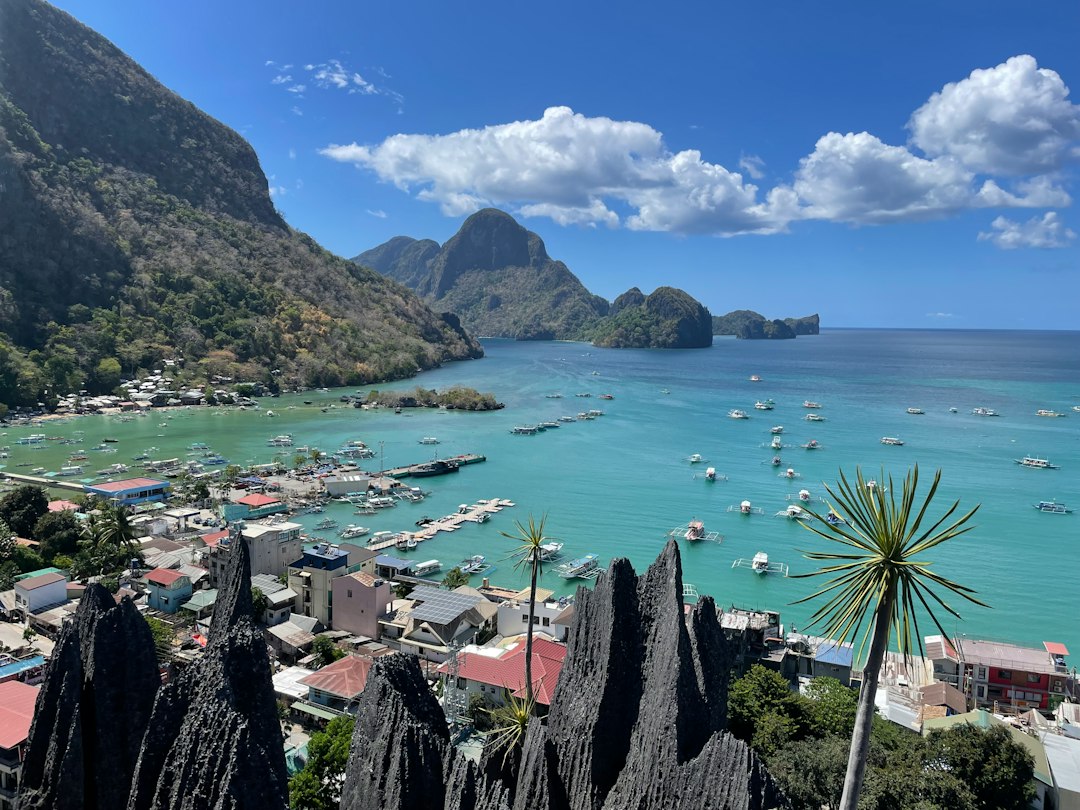

The water changes color three times before the boat touches the shore: first it is a deep blue and almost purple offshore, then it shifts to a bright turquoise as it approaches the rocky walls, finally becoming transparent emerald green in the spots where the white sand bottom reflects the sunlight. This is what you see when arriving at El Nido Bay, in the province of Palawan, in northern Philippines. The limestone cliffs that rise vertically from the sea — some exceed one hundred meters in height — are the result of millions of years of marine erosion and carry with them an irregular and imposing geometry that resembles nothing built by man.
El Nido is located at the northern tip of Palawan Island, about 240 kilometers north of Puerto Princesa, the provincial capital. The village is the mandatory starting point for boat trips to the lagoons and hidden beaches of the surrounding archipelago, which includes over forty islands and islets. The territory is part of the Bacuit Archipelago, a protected area that falls within the larger biosphere reserve recognized by UNESCO for its marine and terrestrial biodiversity.
The hidden lagoons and the white sand
The most famous destinations of the archipelago are reached through the so-called island hopping tours, organized into four numbered itineraries (Tour A, B, C, and D) that cover different combinations of islands and lagoons. Tour A is the most requested and includes the Big Lagoon and the Small Lagoon of Miniloc Island, two bodies of water completely enclosed by limestone walls where you enter by kayak through a narrow passage in the rock. Inside, the water is still, light emerald in color, and the silence is almost total.
The sand of El Nido's beaches is very fine white, almost powdery to the touch, and in some areas it is so compact that it does not yield under the weight of feet. Seven Commandos Beach, included in Tour A, is one of the most accessible beaches and offers hammocks among the palm trees and a basic drink service. More isolated is Nacpan Beach, reachable by land about 17 kilometers from the center of El Nido: four kilometers of continuous sand with very little tourist infrastructure, where the sea is rougher and suitable for free swimming during the central hours of the day.
The Colors of Water and the Underwater Atmosphere
The transparency of the water in many bays of the archipelago allows you to see the seabed at depths of six or seven meters without a mask. The most frequented snorkeling areas are around the coral reefs of Shimizu Island and Matinloc Island, where clownfish, sea turtles, and schools of surgeonfish live. Visibility varies greatly with the seasons: in the dry months, between November and April, it can exceed fifteen meters, while during the rainy season it significantly decreases due to sediment runoff from the hills.
The overall atmosphere of El Nido Bay is that of a place still partially wild, where rocky walls drop directly into the sea without intermediate beaches and where navigation requires caution due to shallow waters and emerging corals. The local boat pilots — called bangka, the typical Philippine outrigger boats — have known these waters for generations and maneuver with a precision that becomes evident in the narrowest passages between the rocks.
How to organize the visit practically
The bangka tours generally depart from the El Nido waterfront between 8:00 and 9:00 in the morning and return in the late afternoon. The indicative cost for a group tour ranges from 1,200 to 1,800 Philippine pesos per person (about 20-30 euros), including stops for lunch on a beach. It is advisable to book the day before directly with one of the local operators along the main street of the town, as spots on the boats are limited and during the high season months (December-March) they fill up quickly.
To get to El Nido from Manila, there are direct flights operated by local companies such as Air Swift, with a duration of about an hour and a half. Alternatively, you can fly to Puerto Princesa and continue by shared van for about five or six hours on a partly unpaved road. The most useful advice for first-time visitors is to choose the middle days of the week for tours: the weekend attracts many visitors from Palawan itself, and the most famous lagoons can become crowded during peak hours between 10:00 and 12:00.
When to go and what to expect
The best season to visit El Nido Bay is between November and April, when the sky is mostly clear and the sea is calm. From May to October, the area is exposed to the southwest monsoon, which can make navigation impossible for entire days. Even in the dry season, cloudy mornings are common, and full sun often arrives only after 9:30 AM. Bringing high SPF sunscreen is essential: the reflection of the water on the limestone walls amplifies exposure to UV rays even on days with scattered clouds.
El Nido is not a place for those seeking luxury comfort integrated into the natural landscape: the town is small, electricity can be intermittent in the cheaper accommodations, and internet connection is often unstable. But it is precisely this partial infrastructural imperfection that keeps the quality of the surrounding natural environment intact, where the limestone cliffs continue to reflect in the turquoise water without any human construction managing to overshadow them.