From afar, it looks like a finger of rock pointing towards the sky, a gray-ochre needle that suddenly emerges from the flat plains of western Nebraska. Chimney Rock rises about 120 meters above the panhandle prairies, visible for miles in every direction. It is not a random formation: it is a volcanic plug, the solid residue of an ancient magma conduit that time has exposed by eroding the softer rock around it. The result is a column of tuff, consolidated ash, and clay that defies gravity with an almost artificial verticality.

What surprises the modern visitor is the same thing that struck 19th-century American pioneers: the impossibility of ignoring it. Along the Oregon Trail, the migratory route that between the 1840s and 1860s brought hundreds of thousands of settlers westward, Chimney Rock was the most anticipated signal of the journey. It meant that about a third of the way had been traveled, that the plains were about to give way to the Rocky Mountains. The pioneers' diaries mention it more than any other natural formation along the entire route.
A volcanic landscape out of time
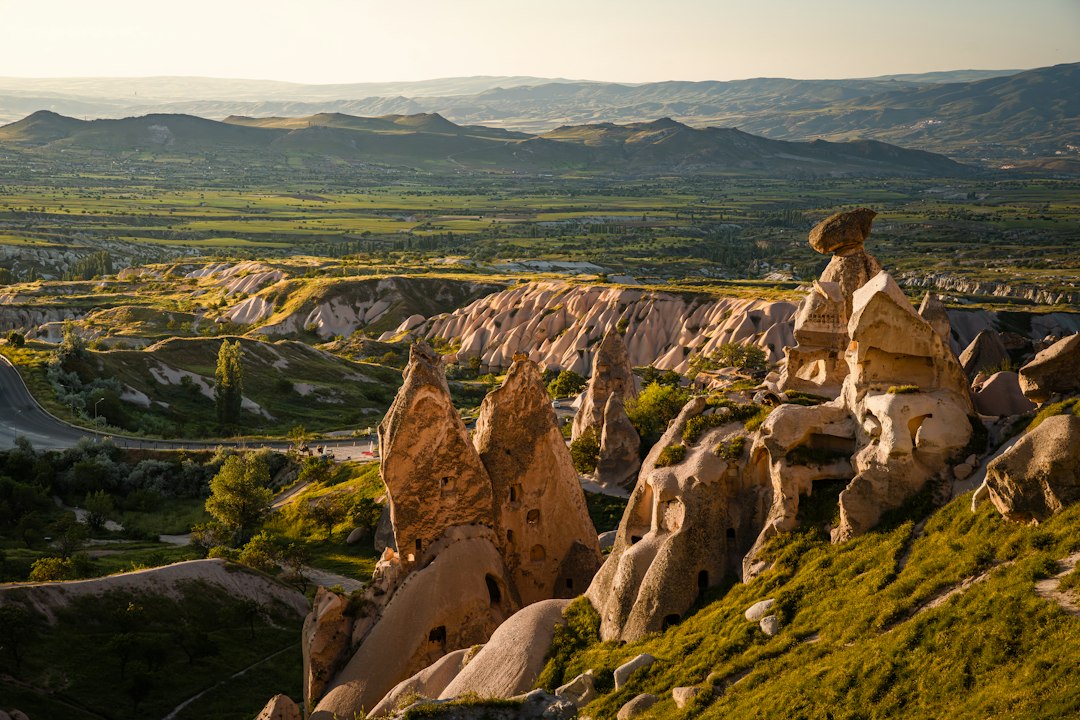
Approaching Chimney Rock means crossing a landscape of badlands that seems to have come from another planet. The eroded hills around the rock show layers of volcanic sediments in shades ranging from chalky white to brick red, a testament to eruptions that occurred tens of millions of years ago. Walking along the path that leads to the base of the formation, it is possible to observe the geological layering directly on the walls of the surrounding hills: each band of color tells a different era of ash deposits and pyroclastic material.
The rock itself is primarily composed of rhyolitic tuff and hardened clays. Its chimney-like shape — from which the name derives — is the product of centuries of wind and water erosion that have sculpted the top more aggressively than the base. Geologists estimate that the formation is still eroding by a few centimeters each year, which means that the pioneers of the 1850s saw a Chimney Rock slightly taller than the one we observe today.
The museum and the history of the pioneers
At the foot of the rock stands the Chimney Rock National Historic Site, managed by the Nebraska State Historical Society. The small museum housed in the visitor center building collects original objects, autograph diaries, and reconstructions that document the migration along the Oregon Trail. This is not a rhetorical celebration: the testimonies on display speak of toil, illness, loss, and resilience with a frankness that makes the visit genuinely moving.
Among the most significant materials are the transcriptions of original diaries written by women and children during the journey, voices often forgotten by the official historical narrative. The museum also contextualizes the conflict with the native populations of the region, particularly the Lakota and the Cheyenne, whose lands were crossed and progressively taken away by the waves of migration. It is a complex story, presented without excessive simplifications.
How to organize the visit
The site is located near the small town of Bayard, Nebraska, along Highway 92. The entrance to the museum requires a modest ticket fee — generally around 3-5 dollars per adult — while access to the outdoor area and the scenic trail is free. The walking path from the parking area to the base of the rock takes about 20-30 minutes of walking on uneven terrain, so comfortable shoes are essential.
The best time to visit is in the early morning or late afternoon, when the slanting light enhances the colors of the badlands and casts long shadows on the plain. In summer, temperatures can be high and the sun on the open prairie is relentless: bringing enough water is not a minor detail. In spring and autumn, the weather is milder and the colors of the landscape are richer. The site is open year-round, but the museum may have reduced hours in winter, so it is worth checking in advance on the Nebraska State Historical Society's website.
Why It's Worth the Trip
Chimney Rock is not easily accessible: it is located in one of the least populated areas of the United States, far from major tourist routes. However, this distance is part of its charm. Getting here, traveling along straight roads that cut through the prairie endlessly, recreates on a small scale the feeling of isolation and direction that the pioneers must have experienced. The rock appears on the horizon long before you reach it, and grows slowly as you approach, just as it did for those who spotted it from covered wagons.
Those who have already visited the great American national parks will find something different here: not the grandeur of the Grand Canyon or the crowds of Yellowstone, but an authentic silence, a forgotten volcanic landscape, and a human story told without filters. It is the kind of place that is remembered not for what it promises, but for what it delivers.