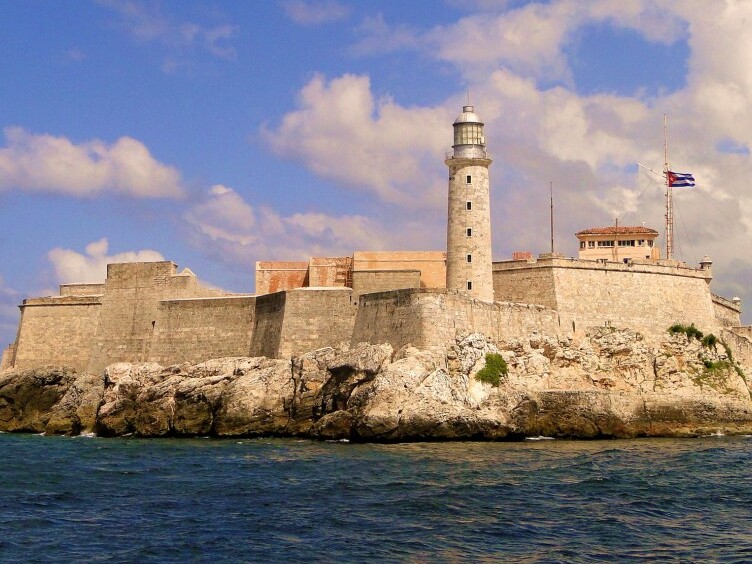

Commercial and political rivalries in the Caribbean region in the 17th century led to the construction of this massive series of fortifications on a rocky promontory, built to protect the important port of Santiago. This intricate complex of forts, magazines, bastions and batteries is the most complete, best-preserved example of Spanish-American military architecture, based on Italian and Renaissance design principles. San Pedro de la Roca Castle, a multi-level stone fortress built on a rocky promontory (El Morro) at the south-eastern tip of Cuba, has guarded the entrance of Santiago de Cuba Bay by 1638. This outstanding castle and its associated defensive works were built in response to commercial rivalry and aggressive policies that threatened the Caribbean during the 17th and 18th centuries; Today, they make up the largest and most complete example of military engineering principles of the Renaissance adapted to the needs of the European colonial powers in the Caribbean. A classic fortification bastion in which geometric shape, symmetry and proportionality between the sides and angles predominate, the Castle is an excellent representative of the Spanish-American school of military architecture. San Pedro de la Roca Castle and its associated batteries of La Estrella, Santa Catalina and Aguadores protect the entrance to the bay and the port of San Diego de Cuba, which was of great importance due to its geographic position, its favorable currents and its protected anchorage. How conflicts between Spain and England grew in the 17th century, the city's governor has ordered the construction of a stone fortress on a strategic point where there was a previous rivellino, following the designs of the famous Italian military engineer Juan Bautista (John the Baptist ) Antonelli. The fortress was built in the steep cliffs of the promontory in a progression of terraces, one above the other, connected by a series of stairs. At the lowest level, just above high tide, it is a fortified gun platform, powder magazine, the command building and guardhouse. Next is the Sacrament of Holy platform, including gun emplacements, a powder magazine and quarters for its garrison. Above it are the El Aljibe, De Adentro and Napoles platforms. This part of the castle took its present form during a reconstruction in the mid-18th century, when they were added to the Bastions north and south. La Santisima Trinidad platform is the highest level of the main castle, and was built in 1660. To the north is Fort La Avanzada, which completes the chain of small defensive works along the north side of the promontory, consists of La Estrella Fort and two strong smaller built in 1660. Added later were the Tower Semaphore, Chapel of the Holy Christ and the Lighthouse, all built in 1840, and two batteries, Scopa Alta and Vigia, built in 1898. the fortress - which is It has been repaired, rebuilt and consolidated several times due to earthquakes and attacks - fell during the early 20th century, due to lack of maintenance, but was restored in 1960. This intricate complex of forts, magazines, bastions and batteries, all based on Italian and Renaissance design principles, is today the most complete and best preserved example of this Spanish-American school of military architecture.