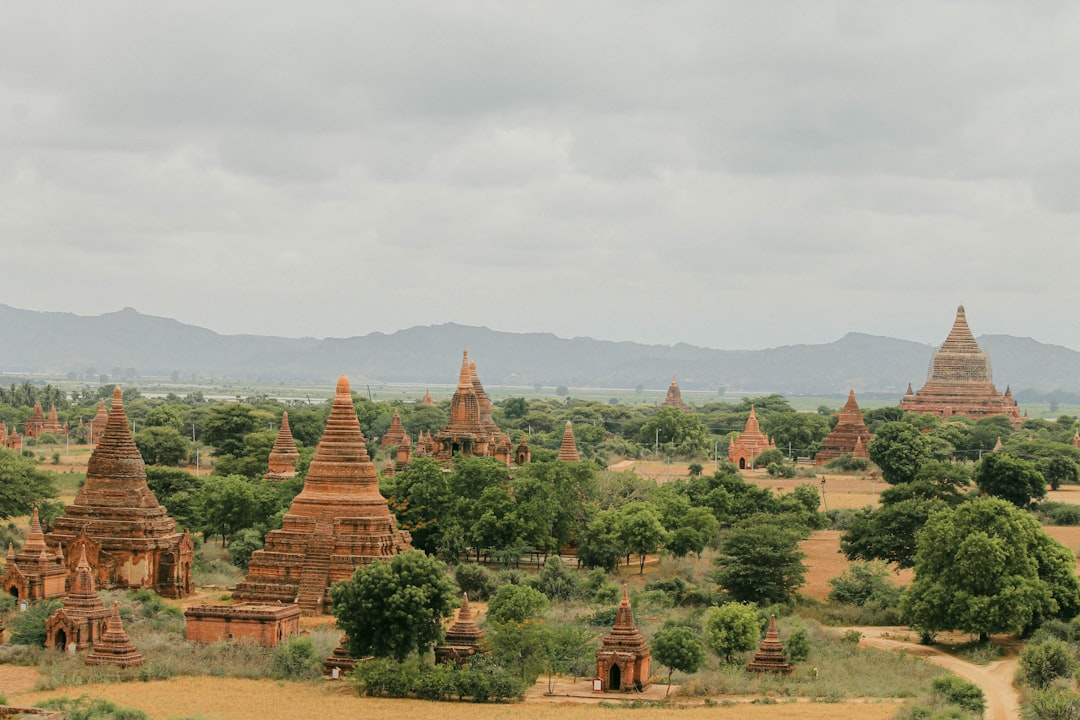

The sun begins to descend towards the horizon and the plain of Bagan slowly transforms into something difficult to describe in words. More than 2,000 Buddhist temples and pagodas emerge from the red dust of the Irrawaddy plain, their golden spires and ochre bricks illuminated by a light that shifts towards intense orange. It is not a scene that belongs to the present: it is like looking through a wide-open window into the 9th century, when the Pagan kingdom was at the height of its religious and architectural power.
Bagan is not a museum site in the traditional sense of the term, even though the Bagan Archaeological Museum collects sculptures, inscriptions, and artifacts that help to contextualize what is seen outdoors. The true collection is the plain itself, a sacred landscape that extends for about 40 square kilometers in the Mandalay region of central Myanmar. Here, between the 11th and 13th centuries, the kings of the Pagan kingdom had thousands of religious structures erected, some of which survive in extraordinary condition.
The sunset viewed from the plain: a concrete experience
The moment of sunset in Bagan is the most anticipated of the day, and for a specific reason: when the slanting light hits the brick walls of the temples, the colors change with a surprising speed. The Ananda Temple, built around 1105 under King Kyanzittha, is one of the largest and best-preserved in the entire plain. Its four Buddha statues, each nearly 9 meters tall, facing the cardinal points, are visible from the inside through dark corridors illuminated by small windows.
The Dhammayangyi Temple, the largest in area of the entire region, was built in the 12th century and has a peculiarity that visitors can physically observe: the bricks of the inner corridor have been bricked up, probably for reasons still debated by historians. Walking around its base at sunset, when shadows stretch between the passages, is a tactile as well as visual experience.
The Bagan Archaeological Museum: what it really contains
The museum is located in the Nyaung-U area, near the logistical center of the region. Inside, it displays artifacts recovered from the excavations and restorations of the temples: inscriptions in Pyu and Mon languages, bronze and stone statues, votive objects, and architectural fragments. One of the most significant pieces is the Myazedi Stone, a reproduction of the quadrilingual inscription from 1113, considered the Rosetta Stone of Myanmar for its value in deciphering the ancient languages of the region.
The museum is not large, and a complete visit takes about an hour and a half. The entrance is included in the archaeological zone ticket, which at the time of writing this article costs about 25,000 kyat (equivalent to about 10-12 US dollars) and gives access to all the main sites for multiple days. It is worth purchasing it at the entrance of the zone and keeping it with you.
How to organize a sunset visit
The most useful advice is also the simplest: arrive at the chosen temple at least one hour before sunset. In recent years, after the earthquake in 2016 that damaged many structures, access to the upper terraces of several temples has been prohibited for safety reasons. This means that it is no longer possible to climb onto all the roofs as it was in the past. Some authorized temples still allow access to the terraces, and local bicycle or taxi operators can indicate which ones are open at a given time.
The most common way to get around the plain is by electric bicycle, available for rent in Nyaung-U for about 8,000-10,000 kyat per day. It allows you to reach temples far from the center without excessive effort, even during the hottest hours. Avoid the central hours of the day, between 11 and 15, when the heat is intense and the flat light makes photographs less interesting. Sunset begins around 17:30-18:00 depending on the season, with the months between November and February considered the best for clear skies and bearable temperatures.
Why Bagan Remains Unique in Its Kind
What makes Bagan different from other Buddhist sites in Asia is the visual density: there is no point in the plain from which at least one spire is not visible on the horizon. Even the lesser-known temples, those without names on the signs, hide internal frescoes from the 12th and 13th centuries in a state of preservation that is surprising, with still vibrant pigments on ancient plaster walls. Bringing a flashlight is essential to see them.
The Bagan plain was included in the UNESCO World Heritage List in 2019, a recognition that has brought new attention and also new restrictions. Respecting access bans, not touching the frescoed surfaces, and not leaving waste in the temple corridors are behaviors that help preserve something that belongs to everyone, not just to those who visit it today.