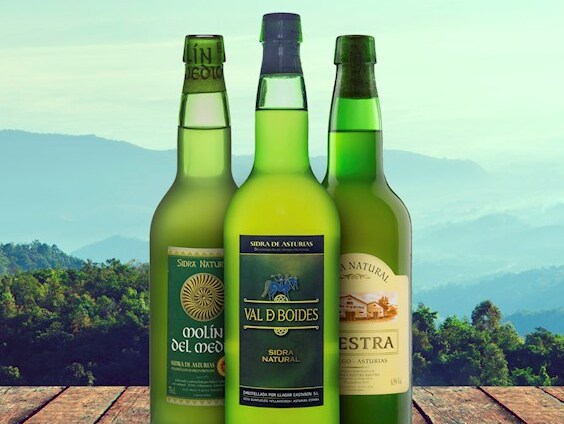

Take a culin is one of the most typical actions of the Spaniard in his free time. It is also true of many visitors to our community. It is a social act, full of forms close to the rite and with the only goal or purpose of conversation, sometimes even disparatar or cachondearse in a winch or bar to use. All this happens more commonly in the so-called cider houses, that over the years have been occupying a privileged place in Asturian leisure, giving concrete physical space to the art of pouring and animosity. As venues that are the consumption of cider, they usually pile up a good number of cider boxes in their interior so that they do not decay, but they also have the appetizers that best come to the Asturian liquid and the most characteristic decoration. At any rate you can drink cider anywhere, and often abounds in festivals and pilgrimages, country walks and events of all kinds that are held outdoors. It is known that taking culinos in excess can lead to a certain intoxication, light or substantial, because despite its low alcohol content, cider has the necessary spark so that, encouraged by the conversation and the bustle of the glass circulating from hand to hand, we reach a high degree of harmony with the environment and the observations of our fellow members. They also arrive, if they pride themselves, the typical exaltations of friendship, some popular song ... If there is bagpipes in between, much better knows the cider and better is passed. Apart from being a friend of cocktail parties and festive fun, cider is a Special seasoning for many regional recipes, and also a unique companion at the table. There are a good number of Asturian dishes that without it lose their reason for being. It is in certain cider houses of unbeatable atmosphere and loaded to the brim where we often stumble upon the slyness that often accompanies these popular gatherings. Everything is full of people, green bottles, corks, sawdust on the floor, trays with nécoras, barnacles or potato omelette. On the walls there are often hanging signs with the odd legendary slogan attributed to cider, and to those who drink it, magical powers or, at least, the gift of joy: The one who muddied two pucheres stayed with an Easter, falatible and gayasperu, without headquarters no week. And do not think: what alone enriquez to the one that faga, give gift to the one who does not have and horros and cases lifts. If we did a little history We would see that cider is not a minor matter. The cultivation of the apple tree in Asturias goes back to the time of the Astures, although it is certain that the terms pomar or pumares have their origin in the Roman epoch. Throughout the Middle Ages, there is a constant mention of the term pomares, as well as dicotations apple, apple, pumares, pomiferous, etc, all names that, with its extension, did not give more specific importance to the apple in Asturias, which was soon known outside its natural territory. From the Middle Ages to the present day, the apple is leading a continuous expansion of cultivation, displacing other fruit trees, such as citrus and some cereals, whose cultivation was basic in the region until the 19th century. In recent years the cultivation has improved a lot, with the insitu study of the problems that affect the native apple tree and with aids and subsidies for lost fund for the farmers that want to dedicate themselves to this activity. The last impulse given to cider, goes through the debate of turning it into a product with denomination of origin. For this purpose, recently all the bottles present a labeling of the producer that guarantees a higher quality. You can also learn a little more about the history of cider, approach its virtues, experience its consumption and recreate the environment of the windlass in the Museum of the Cider of Nava, town that also turns out to be one of the largest cider centers of the Principality.