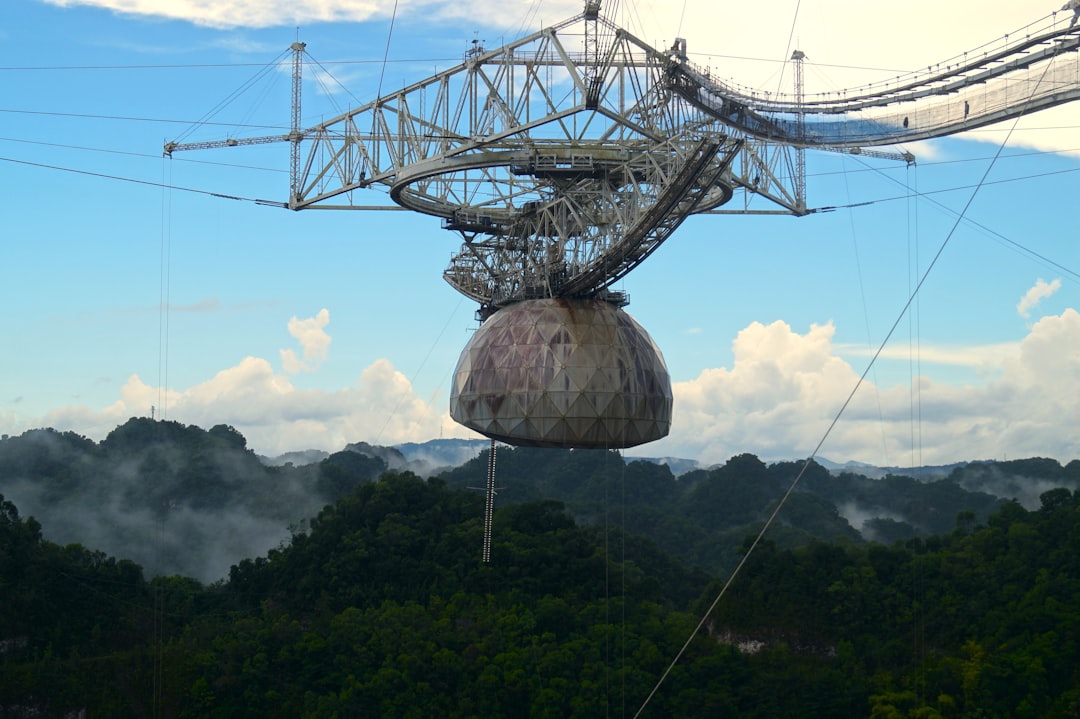

In the heart of the lush forests of Puerto Rico, a gigantic metal paraboloid stands majestically, capturing radio waves from the universe. The Arecibo telescope, with its diameter of 305 meters, has been for decades a symbol of astronomical research and a place of discovery. Not just an engineering feat, but a bridge to infinity, Arecibo has helped unveil the mysteries of the cosmos.
Since its completion in 1963, the telescope has fascinated scientists and astronomy enthusiasts around the world. It has played a crucial role in the discovery of exoplanets, in the observation of pulsars, and in the study of gravitational waves. Every signal captured by this marvel of technology has opened new doors to understanding the universe. But Arecibo is more than just a scientific instrument; it is a place where the dream of exploring space comes to life.
An Icon of Science
The Arecibo radio telescope is an icon of modern science, globally recognized for its groundbreaking discoveries. Its structure, designed to monitor radio waves from celestial bodies, was the first instrument to detect pulsars, neutron stars that emit electromagnetic radiation. This discovery, made in 1967 by Jocelyn Bell Burnell, revolutionized our understanding of astrophysics and paved the way for new research in the field of particle physics.
Over the decades, Arecibo has continued to push the boundaries of science. Its observations of celestial objects such as asteroids and comets have provided vital information for planning future space missions. Additionally, the observatory has contributed to the study of Earth's climate and ionosphere, showing how cosmic events can influence our atmosphere.
A Journey Through Time and Space
Visiting the Arecibo radio telescope means embarking on a journey that is not only physical but also temporal. Guests can explore the visitor center, where interactive exhibits and informational panels tell the story of the observatory and its incredible discoveries. Here, the passion of the scientists is conveyed to the visitors, making science accessible and fascinating.
The path to the telescope is an exhilarating experience: as one approaches, the sound of the lush greenery of the tropical forests is interrupted only by the distant sound of waves crashing on the shore. The structure itself, with its imposing shape, evokes admiration and respect. The highlight is when one reaches the observation platform: from here, the view offers a breathtaking sight of the telescope, which seems almost to embrace the sky.
An Uncertain but Sustainable Future
In recent years, the Arecibo radio telescope has faced significant challenges. Due to structural and financial issues, the observatory has seen its budget and support decrease. In 2020, a series of support cables broke, leading to the temporary closure of the telescope. The future of the site remains uncertain, but its scientific value is undeniable and many hope for a revival.
In efforts to preserve the legacy of Arecibo, scientists and supporters have come together to promote research and scientific education. Initiatives to raise funds and awareness campaigns have been launched with the intent of safeguarding this heritage for future generations. Arecibo represents not only a triumph of engineering but also a symbol of human curiosity and our desire to explore.
An Inheritance of Discoveries
The story of the Arecibo radio telescope is a testament to the power of scientific collaboration and research. Its discoveries have not only expanded our understanding of the universe but have also united people from different cultures and backgrounds. Scientists from around the world have collaborated on innovative projects, contributing to a collective vision of science.
Today, as the world continues to explore and discover, the Arecibo radio telescope remains a symbol of hope and possibility. Its spirit lives on in every research endeavor, in every space probe, in every astronomical observation. Even though the future is uncertain, its legacy of discoveries will continue to inspire generations of scientists, researchers, and dreamers.